
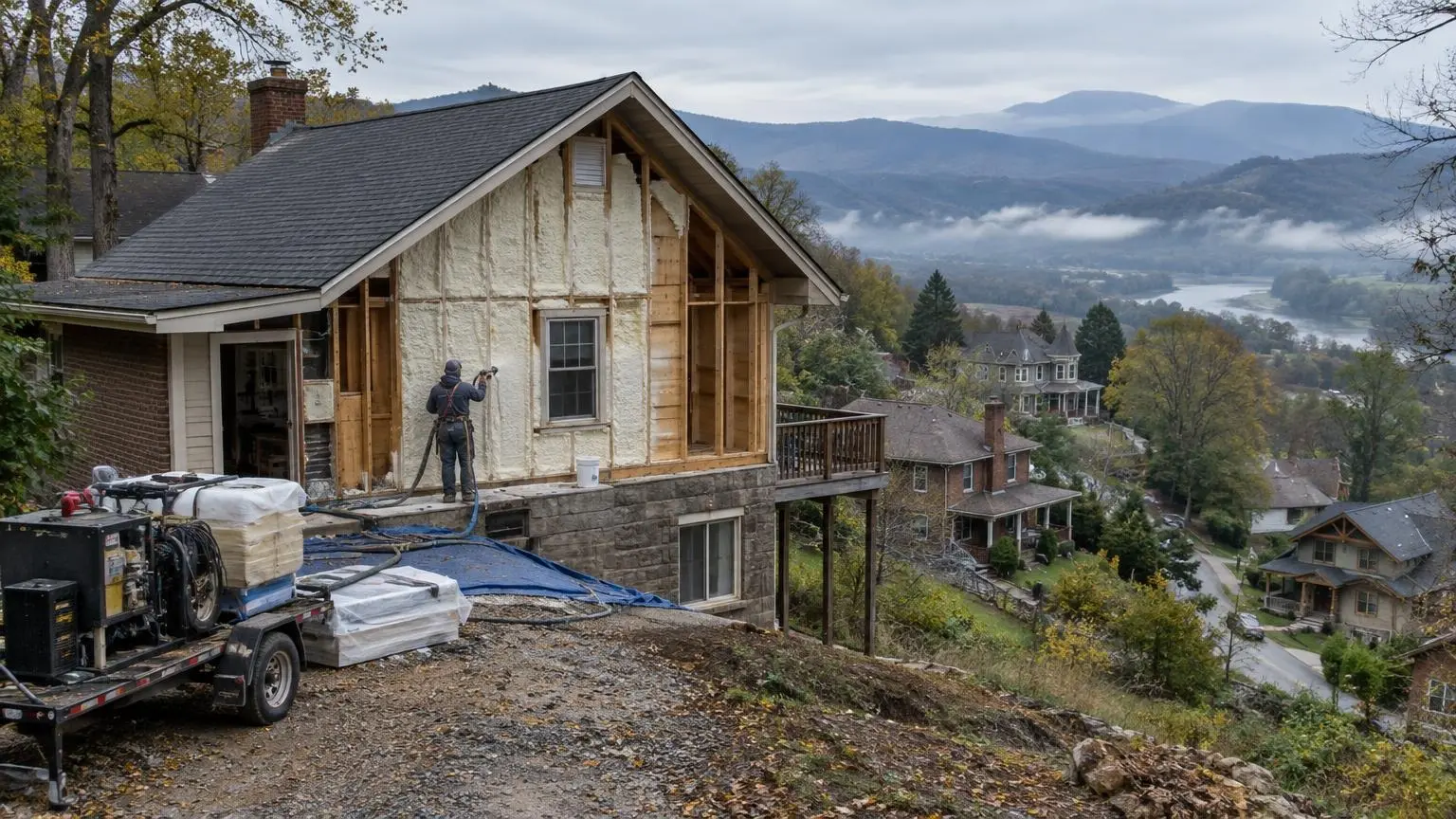
Mountain homes, crawl spaces and attics in Buncombe County
Spray Foam Insulation in Asheville, NC
Seal the crawl space, stop the attic leaks and get a house that holds steady through humid summers and cold mountain nights.
- Free on-site estimates
- Written quote with material, thickness and R-value for each area
- Crawl space moisture checked before anything is sealed
Insulation for Houses Built on Hills, Over Crawl Spaces
Spray foam insulation in Asheville has two jobs. In winter it keeps heat in a house that sits at about 2,130 feet, where the 1991 to 2020 climate table on Wikipedia shows a January daily mean of 38.7F and a record low of -16F. In summer it keeps damp air out of crawl spaces and attics during a season that brings most of the city's 49.59 inches of yearly precipitation. We spray open-cell and closed-cell foam where each one fits, encapsulate crawl spaces, and blow in insulation where that does the job for less.
What the code and the climate ask for
OpenEI's county list of ASHRAE 169 climate zones puts Buncombe, Henderson, Haywood and Madison counties in Climate Zone 4A, the mixed-humid zone. The six highest counties of the North Carolina mountains (Alleghany, Ashe, Avery, Mitchell, Watauga and Yancey) are the only ones in Zone 5A. North Carolina builds to the 2018 North Carolina Energy Conservation Code, which the Insulation Institute describes as the 2015 IECC with state amendments, effective January 1, 2019; its ceiling line reads R-38 or R-30 continuous insulation. For existing homes, ENERGY STAR sets the retrofit target higher: in Zone 4A an attic with no insulation should reach R-60, an attic with 3 to 4 inches already in place should gain about R-49, and an insulated floor over a crawl space should reach R-19.
Where Asheville houses lose energy
Asheville grew fast in the 1910s and 1920s, and the city's Art Deco downtown, the Victorian houses of the Montford Area Historic District and the Arts and Crafts style of the Grove Park Inn all date from that era of building. Houses from that time and the post-war decades share a few habits: open framing that lets air run from the crawl space to the attic, little or no insulation in walls, kneewalls and bonus rooms under steep roofs, and vented crawl spaces sitting over damp soil. Newer homes on ridge lots bring their own: vaulted ceilings with no attic, walk-out basements, and rooms over garages.
The weak spots are predictable. Warm, moist air rises out of the crawl space, through gaps around pipes and wiring, and out through the attic. In summer the opposite happens: humid outdoor air pours into a vented crawl space and condenses on cool ductwork and floor joists. Sealing those paths is what makes the rest of the insulation work.
Closed cell vs open cell
Closed-cell foam cures hard and dense. HomeGuide rates it at R-5 to R-7 per inch, and at normal thickness it acts as a vapor retarder and does not soak up water. That makes it the usual choice for crawl space walls, rim joists, below-grade walls and roof decks with no room for venting. Open-cell foam is softer, expands more, and rates R-3.5 to R-3.7 per inch. It seals air and dampens sound well, and it fits interior walls, above-grade cavities and many unvented attic rooflines. Each one is matched to the space it goes into, and the reason for every choice is written into your quote.
Crawl spaces after Helene
In September 2024, Hurricane Helene brought record flooding on the French Broad and Swannanoa rivers. Many crawl spaces in Asheville, Swannanoa, Black Mountain and the river towns took on water, and fiberglass batts that got wet tend to sag, hold moisture and lose most of their value. If your crawl space flooded, the first step is drying it and pulling the wet insulation. After that, encapsulation with a sealed liner, closed-cell foam on the walls and a plan for any remaining water can leave it drier than it was before the storm.
Questions to ask insulation contractors
When you compare spray foam insulation contractors or insulation companies around Asheville, ask the same questions of each one. Which foam goes where, and why? What thickness and R-value will each area reach? What gets air sealed before insulation goes on? How will the crawl space stay dry, and does the plan include a dehumidifier or a conditioned supply? How long should you stay out after spraying (HomeGuide advises at least 24 hours)? The answers tell you who has thought about your house. We write ours down.
Spray foam insulation cost
HomeGuide's 2026 guide puts installed spray foam at $1.50 to $5.00 per square foot, with open-cell at $1.50 to $3.50 and closed-cell at $3.00 to $5.00. It lists an attic at $3,000 to $8,000, rim joists at $2,000 to $2,500 and a whole house at $8,000 to $20,000, and notes that many installers set a minimum of $1,000 to $2,000 or more. Crawl space encapsulation runs $3 to $10 per square foot in HomeGuide's encapsulation guide. Those are national numbers. Access on steep lots, crawl space height, prep work and any removal set the real figure, and the number on your written estimate is the one you pay.
Spray foam insulation near me: what we cover
We work across Asheville and Buncombe County, south to Fletcher, Arden, Mills River and Hendersonville, west to Candler, Canton and Waynesville, north to Weaverville, Woodfin, Leicester, Mars Hill and Marshall, and east through Swannanoa, Fairview and Black Mountain. Each town page lists what is different there.
Towns We Serve Around Asheville
Asheville and its neighbors share the same mountain climate, but the houses differ town to town. Woodfin, Swannanoa and Canton grew around mills and still hold mill-village houses. Hendersonville, Arden and Weaverville have historic neighborhoods from the late 1800s and early 1900s. Fletcher, Mills River and Fairview mix farm valleys with newer subdivisions. Black Mountain, Swannanoa and Marshall took serious flood damage in 2024. Waynesville and Mars Hill sit higher and run cooler. Pick your town below for the details.
- Spray Foam Insulation in Asheville, NC
- Spray Foam Insulation in Black Mountain, NC
- Spray Foam Insulation in Swannanoa, NC
- Spray Foam Insulation in Weaverville, NC
- Spray Foam Insulation in Woodfin, NC
- Spray Foam Insulation in Fairview, NC
- Spray Foam Insulation in Fletcher, NC
- Spray Foam Insulation in Arden, NC
- Spray Foam Insulation in Candler, NC
- Spray Foam Insulation in Leicester, NC
- Spray Foam Insulation in Hendersonville, NC
- Spray Foam Insulation in Mills River, NC
- Spray Foam Insulation in Canton, NC
- Spray Foam Insulation in Waynesville, NC
- Spray Foam Insulation in Mars Hill, NC
- Spray Foam Insulation in Marshall, NC
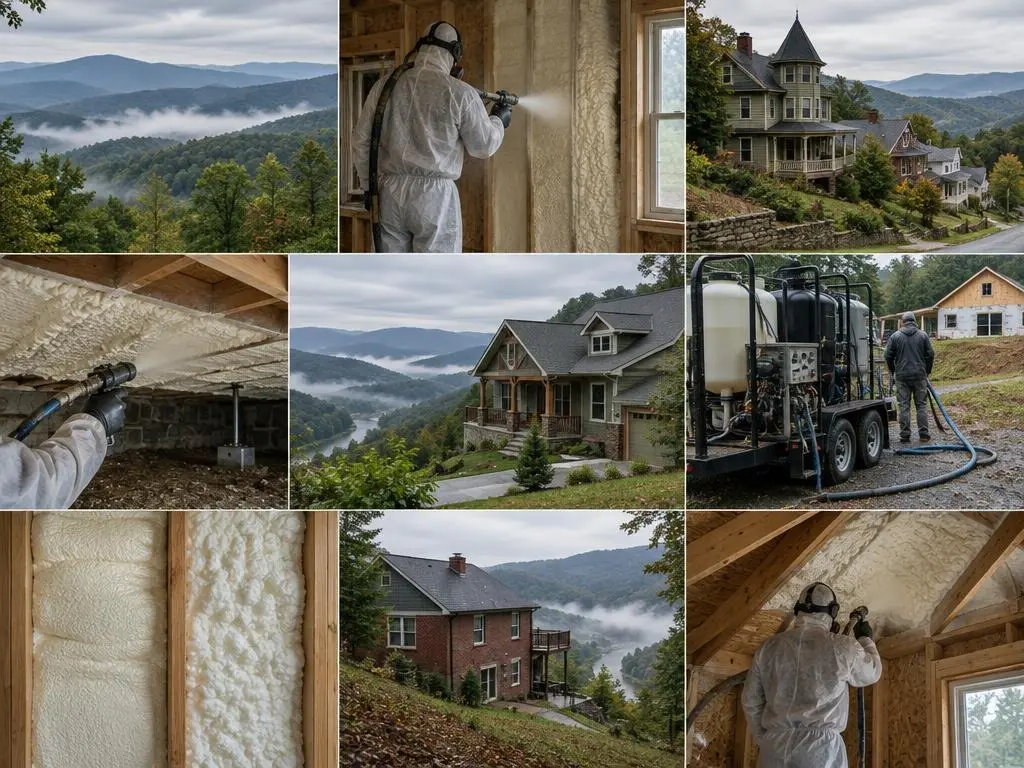
Common Questions
What R-value insulation do I need in my attic in NC?
The 2018 North Carolina Energy Conservation Code lists R-38 (or R-30 continuous) for ceilings in new work. For an existing Asheville home in Zone 4A, ENERGY STAR recommends reaching R-60 when the attic has no insulation and adding about R-49 when it already has 3 to 4 inches.
What is the downside of spray foam insulation?
It costs more per square foot than fiberglass or cellulose, it is hard to remove once cured, and it needs a careful install: correct mix, correct thickness and time for the house to ventilate (HomeGuide advises staying out at least 24 hours). It also should not cover a leak or wet framing. Used in the right places, those downsides are manageable.
Should I encapsulate my crawl space or insulate the floor above it?
In the humid valleys around Asheville, a sealed and conditioned crawl space with foam on the walls usually keeps floors, ducts and joists drier than a vented crawl with batts in the floor. If the crawl space floods or holds standing water, the drainage has to be fixed first. We look before we recommend either.
How much does spray foam insulation cost in Asheville?
National figures from HomeGuide run $1.50 to $5.00 per square foot installed, about $3,000 to $8,000 for an attic and $8,000 to $20,000 for a whole house. Steep lots, low crawl spaces and removal work change the total. We measure and send a written estimate, and that figure is the price.
Is closed cell or open cell better for a mountain house?
Both have a place. Closed-cell goes on crawl space walls, rim joists, basement walls and roof decks where moisture is a concern. Open-cell fits interior walls and many attic rooflines where sound control and air sealing matter more than vapor control.
My crawl space flooded during Helene. Can it be insulated now?
Yes, once it is dry and the wet insulation is out. Wet batts hold moisture against the floor framing, so they come out first. Then we can liner and seal the crawl space and foam the walls, after confirming water will not keep coming back in.
What We Do
Six services, chosen space by space: foam where moisture and air leaks meet, blown-in where depth matters most, and a sealed crawl space under it all.
Spray Foam Insulation
Closed-cell and open-cell foam that insulates and seals air leaks in one pass, sprayed where each type works best.
Learn more →Crawl Space Encapsulation & Insulation
A sealed, lined crawl space with foam on the walls, built to keep mountain humidity out from under the house.
Learn more →Attic Insulation & Air Sealing
Seal the leaks in the attic floor, then bring it up to depth with blown-in or foam, whichever fits.
Learn more →Wall Insulation
Insulation for closed walls in older homes and open walls during remodels and additions.
Learn more →Blown-In Insulation
Loose-fill cellulose or fiberglass blown into attics and closed cavities to reach full depth for less money.
Learn more →Insulation Removal & Replacement
Out with wet, moldy, rodent-damaged or flood-soaked insulation; in with a clean, sealed install.
Learn more →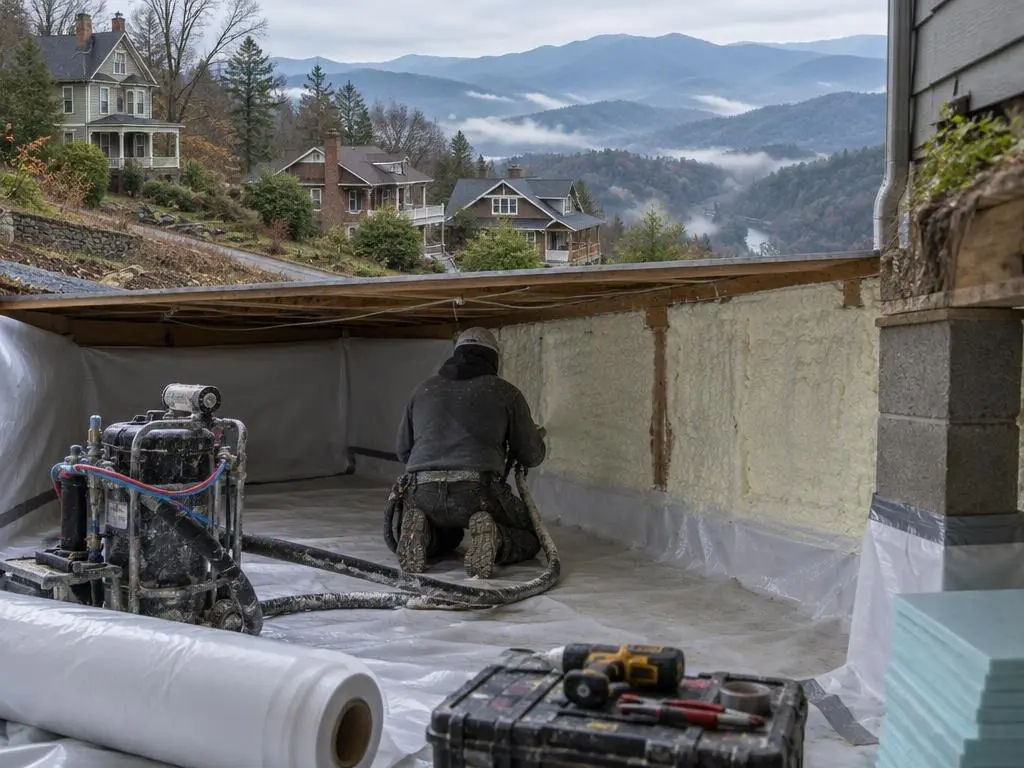
Why Homeowners Call Spray Foam Insulation Asheville
We start under the house
Crawl space moisture drives comfort and air quality in these valleys, so we check it on every visit, even when you called about the attic.
Every area priced on its own line
Your quote lists material, thickness, R-value and price for each space, so you can do the work in stages if you want.
Seal first, then insulate
Chimney chases, plumbing stacks, top plates and rim joists get sealed before new insulation covers them.
Foam only where it earns its cost
On a wide, open attic floor, blown-in over a sealed ceiling often costs less and works as well. We tell you when that is the case.
Get a Spray Foam Insulation Estimate
We come out, measure every space and send a written quote. No charge for the visit.