
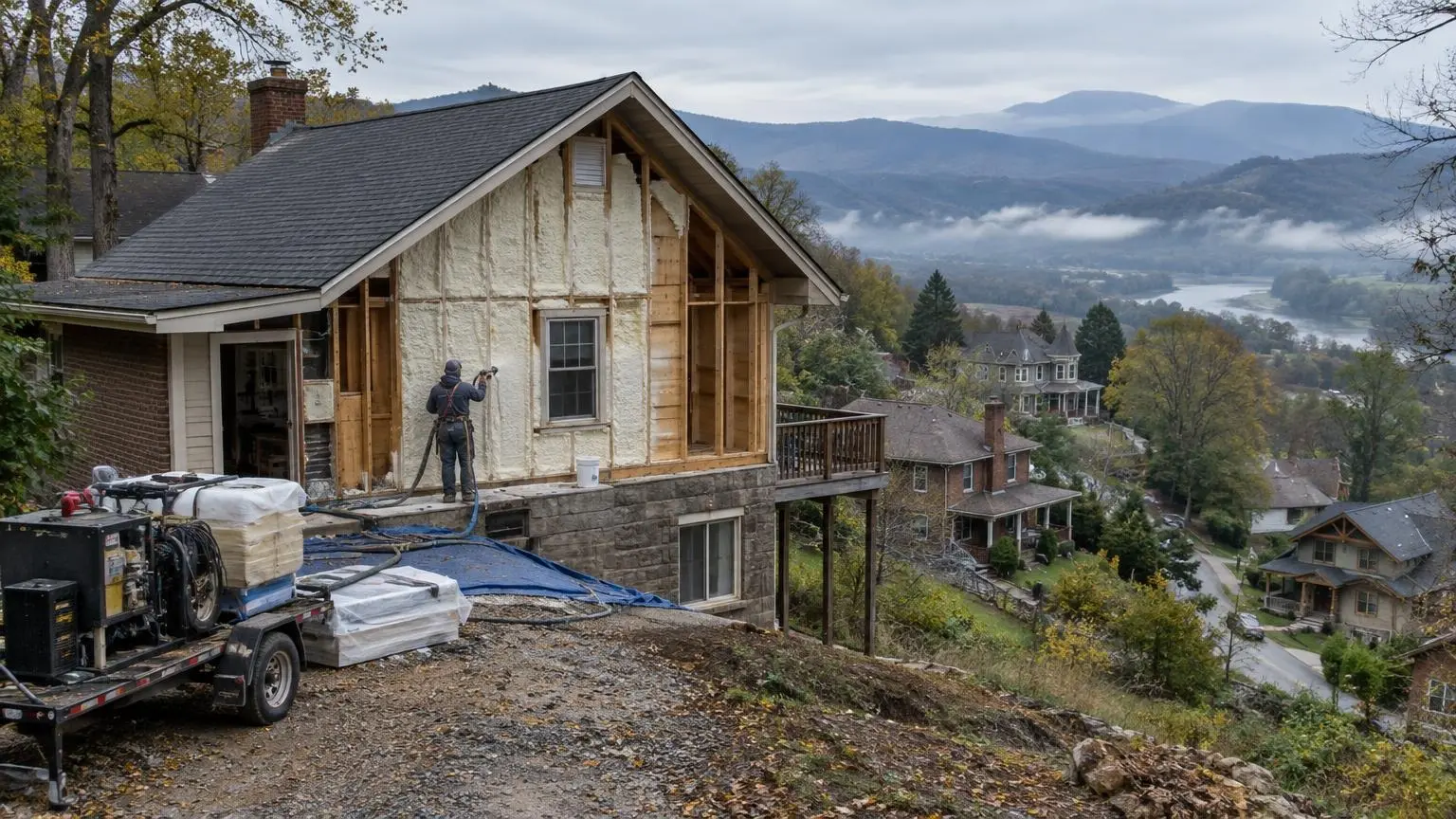
Open-cell and closed-cell foam
Spray Foam Insulation in Asheville, NC
Foam matched to each surface, from crawl space walls to vaulted ceilings.
- Free on-site estimates
- Written quote with material, thickness and R-value for each area
- Crawl space moisture checked before anything is sealed
One Material, Two Very Different Foams
Spray foam insulation goes on as a liquid, expands into gaps and cures in place, so a single layer both insulates and stops air. In Asheville homes that matters in two seasons: winter, when heated air escapes through the attic and pulls cold air in at the crawl space, and summer, when humid air drifts in and condenses on cool surfaces. We spray two kinds of foam, and choosing between them is the first decision on every job.
Closed cell vs open cell
Closed-cell foam is dense and rigid once cured. HomeGuide lists it at R-5 to R-7 per inch. At typical thickness it slows water vapor and does not absorb water, and it stiffens the surface it bonds to. Open-cell foam is light and spongy, expands much further and lists at R-3.5 to R-3.7 per inch. It seals air and quiets sound, but vapor can move through it.
In a mixed-humid climate like Buncombe County's (Climate Zone 4A on OpenEI's county list), those traits point closed-cell toward places that touch the ground or stay damp: crawl space walls, rim joists, below-grade walls and the underside of roof decks with no room for vent channels. Open-cell suits interior walls, above-grade cavities and many unvented attic rooflines.
Where foam pays off in a mountain home
- Crawl space walls and rim joists. Closed-cell seals the band joist and the block walls in one pass and adds insulation where the house meets damp soil.
- Vaulted and cathedral ceilings. Ridge-lot houses often have rooms that follow the roofline with no attic above. Foam against the roof deck reaches a high R-value in a shallow rafter bay.
- Bonus rooms and kneewalls. Rooms tucked under steep roofs lose heat through short walls and the floor behind them. Foam closes the gaps that batts leave.
- Rooms over garages. Floors over unheated garages are a classic cold spot.
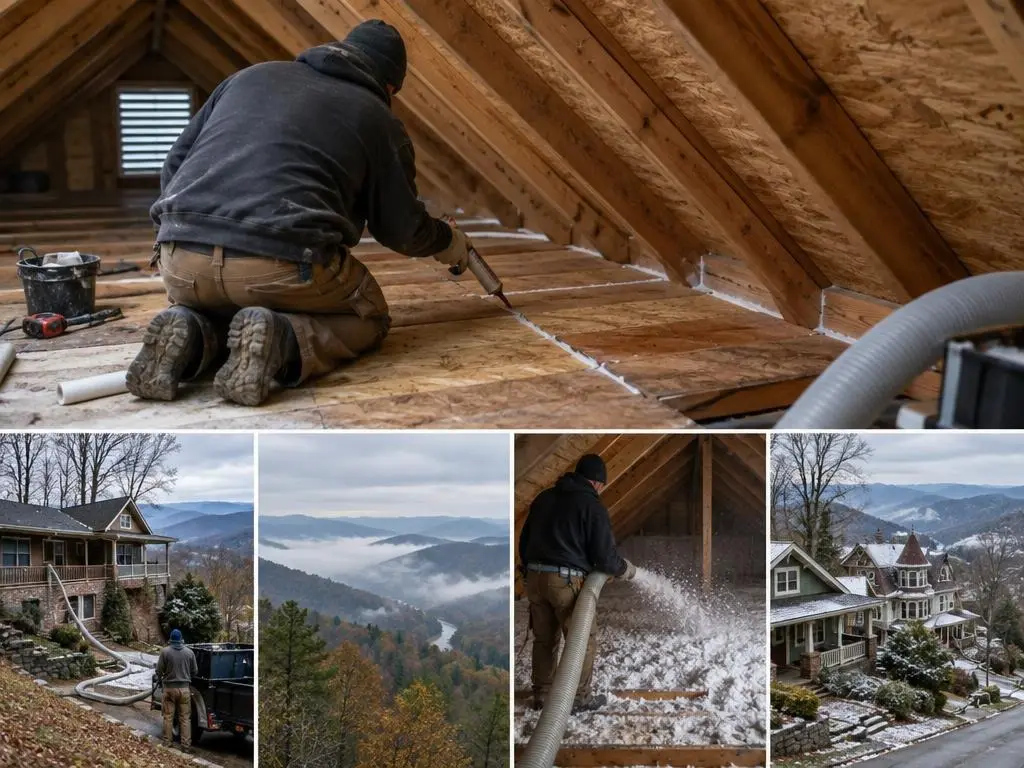
- Attic bypasses. Before blown-in goes on an attic floor, foam seals plumbing stacks, chimney chases and top plates.
What foam does not fix
Foam will not stop a leak, and it should never cover wet framing. Roof, window, plumbing and drainage problems get fixed first. It is also not the cheapest way to insulate a big open attic floor; sealing the leaks and blowing in cellulose or fiberglass usually costs less. If we see old knob-and-tube wiring or vermiculite that could hold asbestos, we stop and tell you before any foam is quoted.
Prep, curing and re-entry
Spraying is fast; prep takes longer. We cover floors and furnishings, mask openings, and set up ventilation. HomeGuide advises staying out of the house for at least 24 hours while foam cures, so plan a day away for interior work. Crawl space and garage jobs often affect the living space less, but we will talk through it for your house.
Where We Spray
Common places foam goes in Asheville-area houses:
Crawl space walls
Closed-cell foam on block or poured walls as part of a sealed crawl space.
Rim and band joists
Air seal and insulate the perimeter where the floor framing sits on the foundation.
Roof decks and vaulted ceilings
Closed- or open-cell under the roof deck where there is no attic or no room to vent.
Kneewalls and bonus rooms
Seal and insulate the short walls and floors around rooms under the roof.
Walls in new framing or remodels
Open studs get open-cell or closed-cell foam before drywall.
Published Spray Foam Insulation Costs
| Job | Published range (source) |
|---|---|
| Spray foam, installed | $1.50 to $5.00 per sq ft (HomeGuide) |
| Open-cell / closed-cell | $1.50 to $3.50 / $3.00 to $5.00 per sq ft (HomeGuide) |
| Roughly 1,000 sq ft | $1,500 to $5,000 (HomeGuide); $3,150 to $7,500 in an existing home (Fixr) |
| Existing walls / new construction | $3.15 to $7.50 / $2.75 to $6.50 per sq ft (Fixr) |
| Exterior walls, whole house | $4,000 to $10,000 (HomeGuide) |
| Whole house | $8,000 to $20,000 (HomeGuide); $10,000 to $30,000 (Fixr) |
| Common job minimum | $1,000 to $2,000 or more (HomeGuide) |
National ranges from HomeGuide (2026) and Fixr (2025). Foam type, thickness, access on sloped lots and prep work all move the total, and small jobs often hit a minimum. What you pay is the figure written on your estimate.
From Visit to Finished Foam
1. Walk-through
We look at every space you want insulated, measure, and note moisture, wiring and access.
2. Written plan
Each area gets a foam type, thickness, R-value and price on the quote.
3. Prep and spray
We protect the house, set up ventilation and apply foam in passes to the planned depth.
4. Check and clean up
We check thickness, trim where needed, clean up and let you know when it is safe to return.
Spray Foam Insulation Questions
How thick should spray foam be?
It depends on the target R-value and the space. Two to three inches of closed-cell is common on rim joists and crawl space walls. Roof decks and walls need more. We write the planned thickness on the quote.
Can spray foam go in an older Asheville house?
Yes, in the right places. Crawl spaces, rim joists, attic bypasses and open walls during a remodel are good fits. Closed walls in an older house are usually better filled with dense-pack cellulose.
Does spray foam cause moisture problems?
Installed correctly, it reduces them by stopping humid air. Problems come from foam over wet framing, the wrong foam in the wrong place, or an unvented attic with no plan for humidity. We plan around all three.
How long until I can go back in?
HomeGuide advises staying out at least 24 hours after spraying. We tell you when the space has cured and ventilated.
Spray Foam Insulation Service Areas
- Spray Foam Insulation in Asheville, NC
- Spray Foam Insulation in Black Mountain, NC
- Spray Foam Insulation in Swannanoa, NC
- Spray Foam Insulation in Weaverville, NC
- Spray Foam Insulation in Woodfin, NC
- Spray Foam Insulation in Fairview, NC
- Spray Foam Insulation in Fletcher, NC
- Spray Foam Insulation in Arden, NC
- Spray Foam Insulation in Candler, NC
- Spray Foam Insulation in Leicester, NC
- Spray Foam Insulation in Hendersonville, NC
- Spray Foam Insulation in Mills River, NC
- Spray Foam Insulation in Canton, NC
- Spray Foam Insulation in Waynesville, NC
- Spray Foam Insulation in Mars Hill, NC
- Spray Foam Insulation in Marshall, NC
Get a Spray Foam Insulation Estimate
Tell us which spaces you want foamed and we will price each one.